The Supreme Court of India will examine the age limits for surrogate mothers and other provisions of the Surrogacy Regulation Act and Assisted Reproductive Technology (Regulation) Act on February 11. The court has asked the government to file its written submissions on the matter. The laws set age limits for intended parents and surrogate mothers, restricting commercial surrogacy and emphasizing altruistic surrogacy. The court is also considering alternative mechanisms for compensating surrogate mothers and has proposed a designated authority for disbursing payments instead of intended couples.
The Supreme Court of India has sought the Indian government's response to a petition filed by a Muslim woman seeking to be governed by the Indian succession law instead of Shariat. The woman, Safiya P.M., argues that she does not believe in Shariat and wants to be governed by secular law, including the Indian Succession Act of 1925. The court has asked the government to file a counter affidavit within four weeks.
Commencing hearing on pleas challenging the constitutionality of the Places of Worship Act, 1991, the Supreme Court asked the Centre to reply to cross-pleas against or seeking implementation of statute.
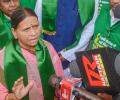
Bihar Chief Minister Nitish Kumar engaged in a heated exchange with Leader of the Opposition Rabri Devi in the Legislative Council, dismissing her as "inconsequential" without her husband, RJD president Lalu Prasad. The spat stemmed from RJD MLCs wearing badges promoting quota hikes passed during Tejashwi Yadav's tenure as Deputy CM, which Nitish Kumar perceived as an attempt to claim credit for the populist move. Kumar also remarked that Rabri Devi was only propped up by her husband when he was in trouble, referring to her becoming Chief Minister in 1997 while Lalu Prasad faced corruption charges. The war of words between the two rivals has intensified, with the RJD accusing Kumar of losing his mental balance and being unfit to rule.
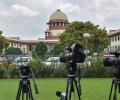
The Supreme Court on Tuesday appointed senior advocate P S Patwalia as amicus curiae to assist it in examining whether an MP or MLA can claim immunity from criminal prosecution for taking a bribe to make a speech or vote in the legislative assembly or Parliament.
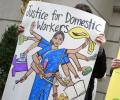
The Supreme Court of India directed the government to establish a legal framework to protect domestic workers and address their exploitation.
"This is complete abuse of the process," said the bench comprising Chief Justice D Y Chandrachud and justices JB Pardiwala and Manoj Misra while junking the PIL on the issue.

PWD Minister Ashok Chavan later told reporters that the application was filed on Monday morning and added the counsels representing the government will try to see that the hearing on the application takes place soon.
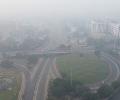
An AQI of 400 or higher is deemed 'severe' and it can have an adverse effect on both healthy individuals and people who already have medical conditions.

Has death penalty in the statute served as a deterrent for heinous crime?

A Bench headed by Chief Justice K G Balakrishnan said the matter will be heard by a five-judge Constitution Bench

The petition contended that the poll panel erred in holding that disqualification under the Tenth Schedule and proceedings under the Symbols Order operate in different spheres and that disqualification of MLAs is not based on cessation of membership of a political party.

The Supreme Court of India has announced its intention to establish an effective mechanism to address caste-based discrimination in educational institutions throughout the country. The court directed the University Grants Commission (UGC) to draft regulations to prevent such discrimination and to provide data on institutions that have implemented equal opportunity cells as mandated by the 2012 UGC equity regulations. The court's decision stems from a public interest litigation filed in 2019 highlighting the prevalence of caste-based discrimination in higher education institutions and its tragic consequences, including the suicides of students like Rohith Vemula and Payal Tadvi.

The apex court said when a particular structure is chosen all of a sudden for demolition and the rest of similarly situated structures in the same vicinity are not even being touched, "mala fide may loom large".

The Delhi high court on Tuesday refused to entertain a plea seeking directions to enrol Rohingya refugee children in local schools, saying it was the Centre's domain.
Commencing final arguments on a batch of pleas against the verdict, the bench, heard senior lawyers including Abhishek Manu Singhvi, Salman Khursheed and Menaka Guruswamy for the petitioners.
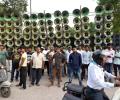
The Bombay High Court has ruled that the use of loudspeakers is not an essential part of any religion and has directed law enforcement agencies to take prompt action against loudspeakers that violate noise pollution norms. The court also ordered the state government to direct religious institutions to adopt mechanisms for controlling noise levels, including calibrated sound systems with auto-decibel limits. The decision came in response to a petition filed by two housing associations alleging police inaction against noise pollution caused by loudspeakers installed on mosques in the area.
The Supreme Court on Friday referred two petitions seeking quashing of the controversial 'single directive' provision in the Central Vigilance Commission Act to a five-member Constitution Bench.
A five-judge constitution bench of Justices SK Kaul, Sanjiv Khanna, A S Oka, Vikram Nath and J K Maheshwari had reserved its judgement on September 29, 2022.

The top court took note of the submissions of senior advocate Abhishek Singhvi, appearing for the Delhi government, that earlier the challenge was directed against the Ordinance which has now become law after clearance from Parliament.

Justice Chandrachud also dealt with questions about criticism by eminent lawyers on the allocation of cases to particular judges and 'bench hunting', and said the allocation of cases is not "lawyer-driven" and vowed to maintain the credibility of the institution of the Supreme Court.
"The open-ended nature of Section 6A has, with the passage time, become more prone to abuse due to the advent of forged documents to establish, inter-alia (among other things), wrong date of entry into Assam, inaccurate lineage, falsified government records created by corrupt officials, dishonest corroboration of the date of entry by other relatives so as to aid illegal immigrants who are otherwise not eligible under Section 6A by virtue of having entered into Assam after March 24,1971," he noted in a separate 127-page dissenting judgment.
'No judge can take up a matter on its own unless allocated by the CJI as the CJI is master of the court,' the top court said.

The Supreme Court on Friday directed a Sambhal trial court to temporarily halt proceedings in the case over the Mughal-era Shahi Jama Masjid and its survey at Chandausi while directing the UP government to maintain peace and harmony in the violence-hit town.

Observing secularism means to 'live and let live', the Supreme Court on Tuesday said regulating madrasas was in the national interest as several hundred years of the nation's composite culture could not be wished away by creating silos for minorities.
The Supreme Court of India has directed the Odisha government to decide within six weeks on a plea for remission filed by Ravindra Pal alias Dara Singh, who is serving a life sentence for the murders of Australian missionary Graham Stuart Staines and his two sons in 1999. Singh, who has spent over 24 years in prison, claims to have "repented" his actions and seeks an opportunity to reform his character. The court issued the notice after Singh argued that he has already served more than the required period of sentence and that his right to liberty is being jeopardized by the delay in processing his plea.

The Supreme Court on Monday said it has started "action" and disposed of a plea moved by former RSS ideologue KN Govindacharya, seeking a direction for a special arrangement with YouTube to safeguard the copyright of its live-streamed proceedings in accordance with a 2018 judgment.
Rijiju also said the Centre respects judiciary as its independence is "absolutely necessary" for a thriving democracy.

The Supreme Court on Thursday reserved its verdict on the issue whether pleas related to the June 2022 Maharashtra political crisis triggered by the Shiv Sena's division be referred to a seven-judge bench for reconsideration of the 2016 Nabam Rebia judgment.

Article 142 of the Constitution deals with the enforcement of decrees and orders of the apex court.
The Bombay High Court has ruled that Pushpa Ganediwala, the former HC judge who had faced criticism for a series of controversial judgments in POCSO Act cases, is entitled to receive pension on par with a high court judge. Ganediwala was demoted as district sessions judge at the end of her additional judgeship in 2022 following an uproar over some judgments passed by her on the interpretation of what constitutes a sexual assault under the Protection of Children from Sexual Offences (POCSO) Act. She had filed a petition challenging a communication issued by the HC registrar declaring that she was not eligible for pension of a HC judge. The court quashed the communication and directed the registry to fix her pension with 6% interest from February 2022.

CJI Lalit concurred with the minority view of Justice S Ravindra Bhat who held the EWS quota as "unconstitutional" for excluding poor among SCs, STs and OBCs.
The speaker of Parliament or a legislative assembly can decide on the notice seeking his recusal from dealing with disqualification pleas of lawmakers subject to judicial review and can ascertain whether such applications are bona fide or intended only to evade disciplinary action, the Supreme Court said on Thursday.

The move, a first in the country after the Supreme Court order, is intended to consolidate the BJP's Dalit outreach in Haryana.

The Supreme Court criticized the Punjab government for making irresponsible statements regarding farmer leader Jagjit Singh Dallewal's indefinite fast and questioned the intentions of some farmer leaders. The court emphasized that it never directed Dallewal to break his fast but expressed concern for his health and urged medical aid. The bench expressed frustration over the government's attempts to create an impression that they were persuading Dallewal to end his fast, despite the court's directives to provide medical aid.

The SC asked why was there a need to make a public statement when a probe had already been ordered into the matter.

The Supreme Court has directed a Maharashtra authority to respond to a man's plea for initiating contempt action against it after his properties were demolished for allegedly raising anti-India slogans during a cricket match. The petitioner, who hails from Sindhudurg district in the state, claims his house and shop were demolished on February 24 following an FIR against him, his wife, and his 14-year-old son for allegedly raising anti-India slogans during the India-Pakistan Champions Trophy match. The plea argues that the demolition violated the Supreme Court's November 13, 2024 verdict on demolition of properties, which barred demolition without a prior showcause notice and 15 days' time for the aggrieved party to respond. The petitioner seeks directions for initiating contempt proceedings against the chief officer and administrator of the Malvan Municipal Council.
